


Industry Insights, Inspiration Hub
Back in Los Angeles: What Our Second Alibaba.com CoCreate Taught Us About Sourcing in the AI Era
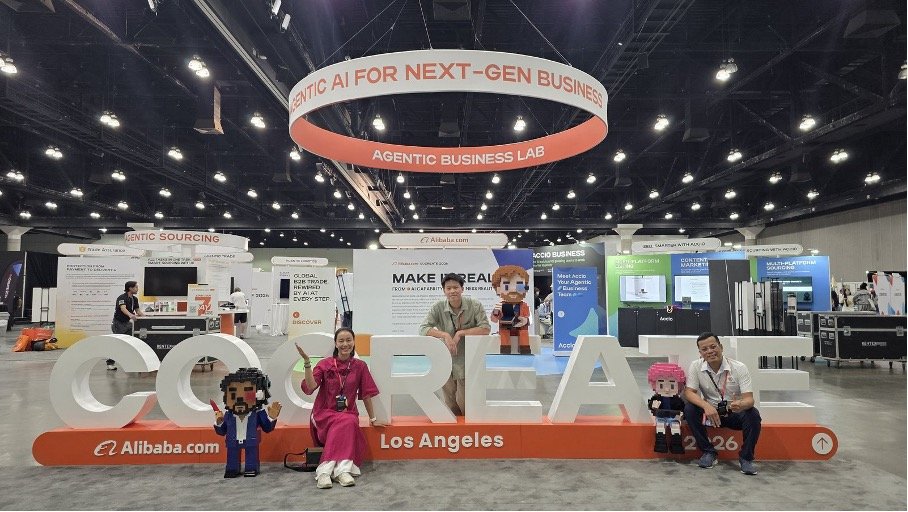
In September we packed our sample library into suitcases and flew from Hanoi to Los Angeles for the second year running. Alibaba.com’s CoCreate summit filled the Los Angeles Convention Center on September 9 and 10, and once again HMG Pop Up Paper had a table on the floor.
A year ago, CoCreate was an experiment for us. Our 2025 debut produced more than 60 qualified commercial inquiries and a featured interview with entrepreneur Daymond John, which made the return trip an easy decision. This year we went back with a different question. Not whether North American buyers want handcrafted pop-up paper, but how they are now finding the people who make it.
Here is what we brought, what we noticed, and what it means if you source paper products for your business.
What CoCreate is, and why a paper workshop goes
CoCreate is Alibaba.com’s summit for product-driven businesses: brand owners, retailers and founders who source from manufacturers and want to meet them in person. The Los Angeles edition was billed as gathering more than 8,000 business buyers over two days.
For a company like ours, meeting in person matters more than it does for most suppliers. Pop-up paper engineering is very hard to judge from a photograph. The value is in the mechanism: how a cathedral rises when the card opens, how a bouquet stands without support, how cleanly the folds return when you close it again. Online platforms are good at putting a supplier on a buyer’s shortlist. They cannot put the card in the buyer’s hand. CoCreate can.
The 2026 theme: sourcing by AI agent
The theme was hard to miss. A ring suspended over the main floor read “Agentic AI for Next-Gen Business,” and the hall was organised around stations for agentic sourcing, agentic logistics and agentic trade. The message from Alibaba.com was that finding a supplier, comparing quotes and parts of the negotiation are increasingly being handled by AI agents working on a buyer’s behalf. The summit’s tagline put it in three words: Make It Real.
We took that theme literally when we designed our booth. The backdrop was built to look like a search result. At the top, a buyer’s request: “I’m looking for a verified 3D popup greeting card supplier.” Below it, the answer an AI sourcing agent might return: HMG, verified supplier, twelve years in business, a full match on the buyer’s criteria, and the three ways we customise.
Then, in front of that backdrop, the real thing. Paper hummingbirds and blossoms hung overhead. A hand-assembled iris bouquet stood on the table. And a pop-up cathedral that visitors kept opening and closing, just to watch it rise again.
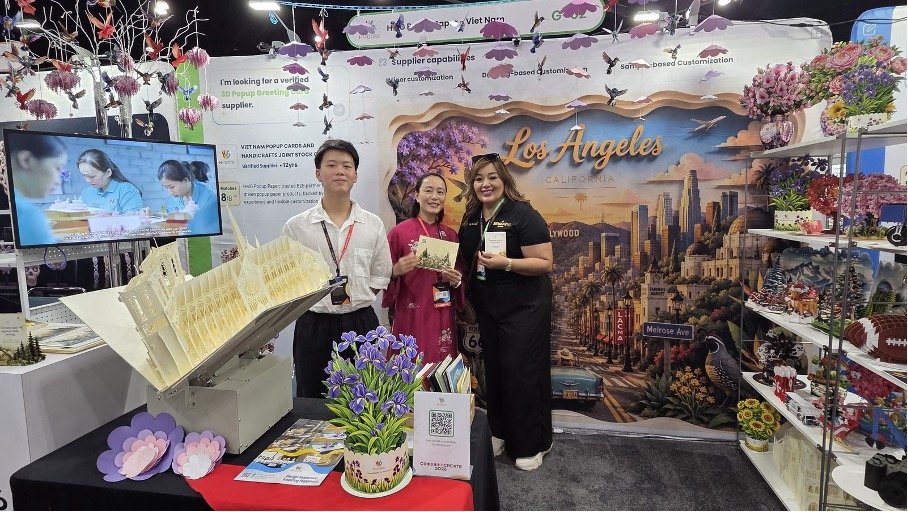
Our booth: a Los Angeles backdrop designed as an AI sourcing result, with hanging paper birds and blossoms, a pop-up iris bouquet and a pop-up cathedral.
Three things we are taking home
Being found is getting easier. Being chosen still happens by hand.
AI tools are compressing the first half of sourcing. A buyer can describe what they need in a sentence and receive a ranked list of manufacturers in seconds. That is good for a specialist workshop like ours, because it means the right buyers reach us faster and the first conversation can start at “can you make this?” rather than “what do you make?”
But the moment that decides an order has not moved. It still happens when someone holds the card, opens it, and sees whether the mechanism is as good as the photo promised. For a craft product, the shortlist can be automated. The decision cannot. That is why we keep showing up in person.
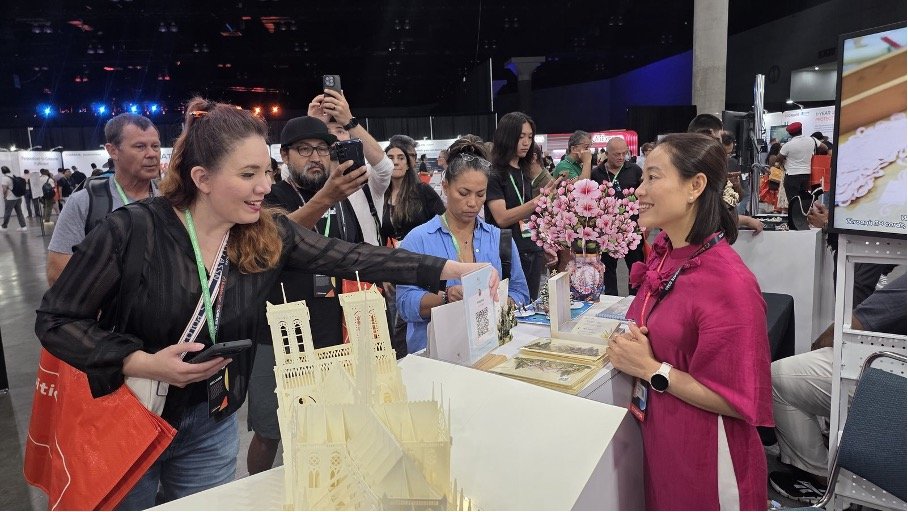
The decision moment: buyers opening our pop-up cathedral at the booth.
Verification is becoming the entry ticket.
When an AI agent filters suppliers, it filters on signals it can check: verification status, years in business, whether production is in-house or subcontracted, what kinds of customisation are offered. A supplier without those signals may never reach a human buyer at all.
For buyers, our advice is simple: ask for the same things the agents look for, and then ask to see the factory’s own work. We design and assemble everything in our own facility in Hanoi, with no subcontracting. That is not a marketing line. It is the reason we can promise consistency across a large order.
Customisation needs a clear starting point.
The three customisation paths on our backdrop are the three ways most projects with us begin:
- Minor customisation. You start from one of our existing designs and change the text, colours or logo. Fastest route, lowest setup.
- Drawing-based customisation. You send a sketch, brief or artwork, and our engineers design the mechanism around it.
- Sample-based customisation. You send a physical sample or reference piece, and we engineer a version of it in paper.
Knowing which path you are on before the first call saves a surprising amount of back-and-forth, and it lets us quote accurately from the start.
Beyond greeting cards
This year we also used CoCreate to show where our work is heading. For more than a decade we have produced custom pop up cards for brands, retailers and corporate clients around the world. More and more of those clients have been asking whether the same engineering can work on other things they send.
So we have started building three new lines on the same folding and cutting techniques: wholesale business cards that open into something memorable, affirmation cards for wellness and gifting retailers, and structural invitations for events and launches.
Inspiring happiness was where we started. Pushing creative boundaries is what comes next.
— [Founder Name], Co-Founder, HMG Pop Up Paper
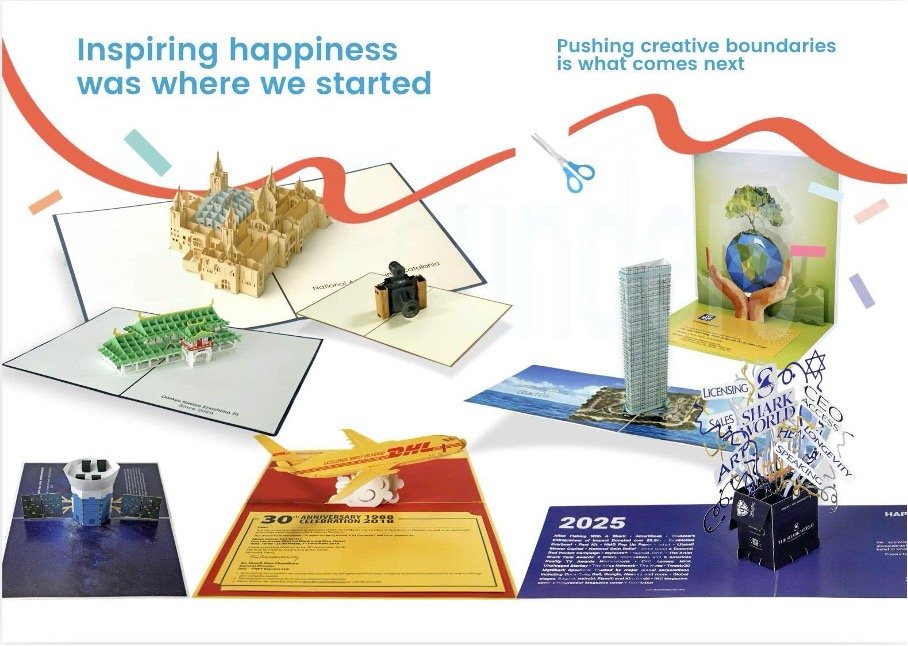
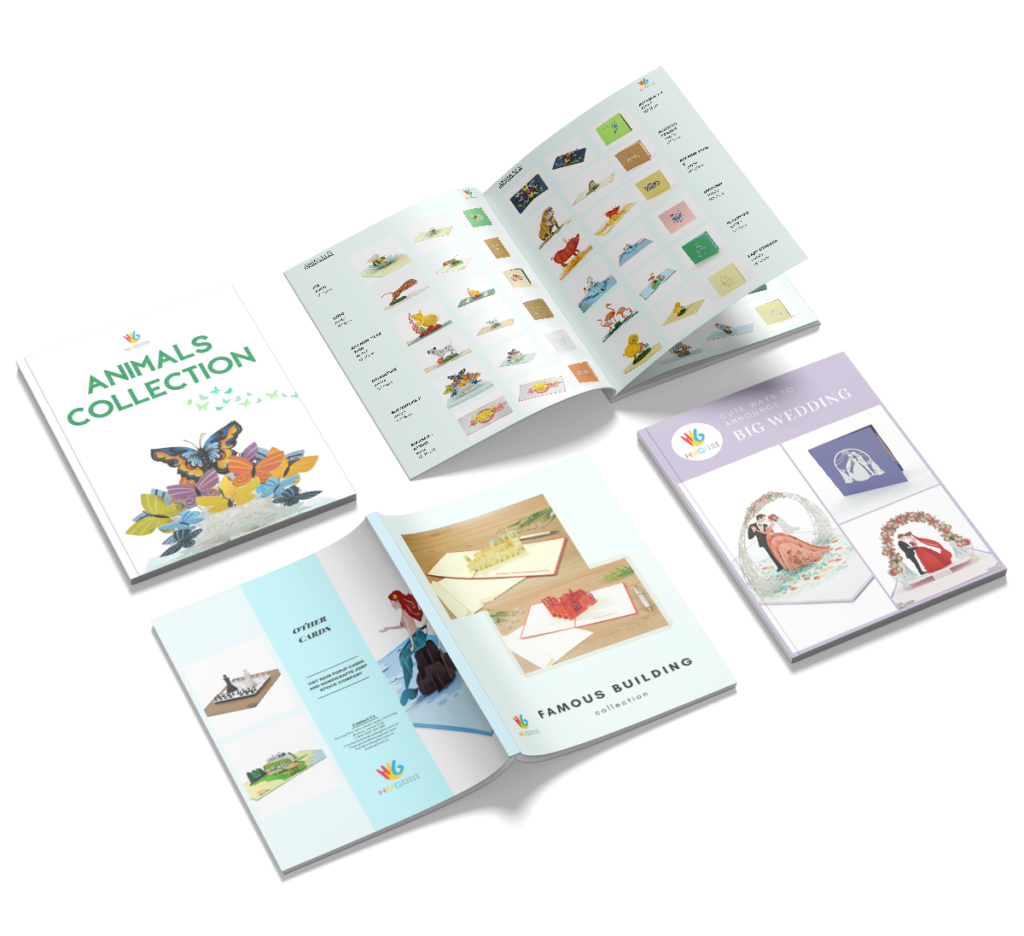
From greeting cards to corporate pieces: a selection of our handcrafted pop-up paper engineering.
Why we keep flying the samples
Bringing a sample library across the Pacific is not cheap, and it is not efficient. We do it anyway, because it is the most honest way to sell what we make.
Sourcing decisions in this category are made by hand, not by catalogue. Buyers need to open the thing. That is why we have flown our samples to Los Angeles two years running.
— [Founder Name], Co-Founder, HMG Pop Up Paper
The same thinking sits behind our Partnership Program. For buyers who plan with us across a full year, we reserve production slots and hold specialty paper in advance, so that peak season does not turn into a queue. Handcraft has a real capacity limit. We would rather allocate it openly than pretend it does not exist.
If you missed us in Los Angeles
You do not need to wait for the next trade show. If you are sourcing pop-up cards, business stationery or invitations, tell us what you have in mind and which of the three customisation paths fits. We will send a sample kit so your team can do exactly what buyers did at our booth: open the cards and judge them by hand.
 3D Facility Virtual Tour
AUTHOR
Hana Phung
As the co-founder and Vice Director of HMG, Hanna Phung stands at the forefront of a decade-long journey dedicated to bringing joy through innovative pop-up card designs. With her visionary leadership, Hanna, alongside her accomplished team, has crafted ...Read More
BLOG
Maybe You Are Interested
Back in Los Angeles: What Our Second Alibaba.com CoCreate Taught Us About Sourcing in the AI Era
In September we packed our sample library into suitcases and flew from Hanoi to Los...
Read more...Rooted at the Border: HMG Supports the “Border Bamboo Rampart” in Lai Châu
On 29 September 2026, at Huổi Luông Border Guard Station in Lai Châu, in Vietnam’s...
Read more...Bringing the Story of Vietnamese Craftsmanship to an International Trade Fair in Hong Kong
A small pop-up card, light enough to sit in the palm of a hand, yet...
Read more...Appreciation Into a Memorable Brand Experience with 3D Popup Card
As the year comes to a close, businesses naturally begin looking back at what they...
Read more...HMG Celebrates Children’s Day 2026 with Gifts for Employees’ Children
At HMG, we believe that a caring workplace extends beyond our employees to the families...
Read more...HMG Spring–Summer 2026 Strava Running Challenge
At HMG, we believe that a healthy team is the foundation of a thriving organization....
Read more...